
Why Security Is Non-Negotiable in Regulated Environments
Some industries simply cannot afford security mistakes. If you’re in law, healthcare, finance, education, government, or any field governed by strict compliance rules, your website is more than a marketing asset; it’s a digital doorway to sensitive information. And with strict privacy laws and increasing cyber threats, the margin for error is extremely small.
That’s why regulated organizations must choose secure WordPress hosting, not standard hosting designed for bloggers or small personal sites. Security-first hosting minimizes risk by protecting your data, preventing unauthorized access, and maintaining compliance with industry regulations. A single vulnerability can lead to fines, legal consequences, reputational damage, or complete operational shutdown.
This guide explains why regulated industries need strengthened hosting environments and which security-specific features actually matter. If your business handles confidential records, financial transactions, or protected personal data, this article will help you understand exactly what to look for in a secure hosting partner.
Why Regulated Industries Face Higher Security Demands
Regulated businesses work with information that cannot fall into the wrong hands. This includes legal case files, medical records, financial documents, student data, government communications, and more. Ordinary hosting is not designed for this level of responsibility.
Industries like healthcare, finance, education, and law operate under strict frameworks such as HIPAA, PCI-DSS, GLBA, and FERPA. These regulations don’t just dictate how you store data internally; they extend to your hosting environment. If your hosting platform isn’t secure, your business isn’t compliant, even if your internal processes are.
The risks are also significantly higher:
- A law firm’s breach could expose privileged documents.
- A clinic’s breach may violate HIPAA and result in massive fines.
- A financial advisor’s breach could compromise client identities.
- A school’s breach could expose thousands of student records.
Beyond the legal and financial consequences, trust is at stake. Regulated industries rely heavily on credibility. Once a security incident occurs, rebuilding that trust is extremely difficult.
This is why security-first hosting isn’t optional – it’s foundational.
Core Features of Security-First WordPress Hosting
Security-first hosting isn’t just “regular hosting with a few plugins added.” It’s an infrastructure designed from the ground up to prevent breaches, protect sensitive data, and maintain compliance. For regulated industries, these features aren’t nice-to-have; they’re non-negotiable.
Advanced Firewalls & Intrusion Prevention
A strong hosting environment includes server-level firewalls that block malicious traffic before it reaches WordPress. This protects against common attacks like SQL injection, cross-site scripting, brute-force attempts, and automated bot networks. Intrusion prevention systems constantly analyze behavior patterns and stop suspicious activity in real time, something standard shared hosting does not provide.
Learn more about how a Premium WP Hosting can provide the same level of security.
Malware Scanning & Automatic Threat Removal
Security-first platforms actively scan for malware across files, core installations, themes, and plugins. If something dangerous is found, it’s removed immediately or quarantined before it can spread. Regulated industries can’t afford multi-day detection windows, mitigation needs to happen instantly, not after a support ticket.
Encrypted Data Storage & Secure Backups
Storing sensitive information requires strict control of how data is kept, accessed, and restored. Secure WordPress hosting ensures that both active data and backups are encrypted, protecting it from unauthorized access even in the event of a breach. Encrypted, isolated backups also allow for quick recovery without risking data exposure.
Multi-Factor Authentication & Login Hardening
Most breaches happen through weak passwords and unprotected admin logins. Security-first hosting enforces strong authentication standards, including MFA, login throttling, IP whitelisting, and bot protection. These measures eliminate the most common entry point for attackers.
Automatic Updates & Patch Management
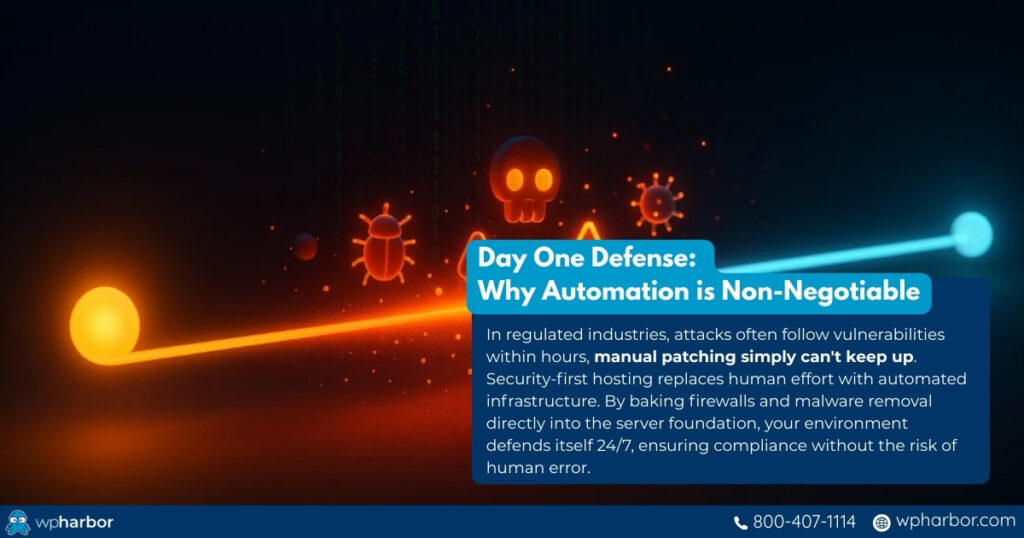
Regulated industries cannot rely on manual updates. Hosting providers must automatically patch WordPress core, plugins, and PHP vulnerabilities. Many attacks exploit outdated components within hours of a vulnerability being announced, automated patching prevents small issues from becoming full-scale incidents.
Audit Logs & Activity Monitoring
Compliance frameworks require organizations to track who accessed what, when, and from where. Security-first hosting includes comprehensive audit logs for admin activity, file changes, updates, and login attempts. This ensures you can demonstrate compliance and trace actions if something suspicious happens.
Secure Development and Staging Environments
Testing new features directly on a live site is a compliance risk. Secure hosting provides isolated staging environments where developers can build, test, and review changes safely. Launches become predictable, controlled, and audit-friendly, without exposing sensitive data.
These core features form the baseline of secure WordPress hosting. If a hosting provider can’t offer them natively, they’re not suitable for regulated environments.
How Secure WordPress Hosting Protects Against Common Threats
Regulated industries face the same cyber threats as everyone else, but with far greater consequences. Security-first hosting is designed to block these attacks at the infrastructure level, minimizing the chance of breaches and reducing the impact if one ever occurs.
Protection Against Brute-Force Attacks
Attackers frequently run automated login attempts across thousands of WordPress sites. Hosting-level rate limiting, login hardening, and IP blocking stop these attempts before they reach application-level security. This reduces server load and eliminates a major source of unauthorized access.
Defense Against SQL Injection & Code Exploits
Poorly configured servers are vulnerable to injection attacks that manipulate databases or compromise data. Security-first hosting uses hardened PHP configurations, Web Application Firewalls (WAF), and real-time request filtering to detect and block malicious payloads instantly.
Mitigation of Zero-Day Vulnerabilities
When a plugin or theme vulnerability becomes public, attackers often scan the internet within hours to exploit unpatched sites. Automated updates, virtual patching, and malware isolation protect your site while official patches are rolled out.
Ransomware & Malware Containment
Should malicious code ever make it past outer defenses, security-first hosting isolates the infection, prevents it from escalating, and restores clean files from secure backups. This containment is critical for regulated industries where downtime and data loss are unacceptable.
Protection From Insider Risks & Unauthorized Access
Not all breaches come from external attackers. Security-first hosting includes granular access controls, audit tracking, and permission management that prevent accidental or intentional misuse by internal users.
Defense Against Bot Traffic & DDoS Pressure
High-volume automated traffic can overwhelm weaker hosting environments. Security-first hosting filters out malicious bots, absorbs DDoS surges, and ensures uptime even under stress. This protects performance, uptime SLAs, and business continuity.
In regulated industries, these protections aren’t optional. They’re safeguards against financial loss, legal exposure, and reputational damage, all of which can stem from a single unchecked vulnerability.
Compliance Requirements Your Hosting Must Support
Regulated industries do not get to choose whether they follow compliance standards; they are required by law. Your hosting environment must support these obligations from the infrastructure level up. Secure WordPress hosting should make compliance easier, not create manual work or risk accidental violations.
HIPAA (Healthcare)
Healthcare providers, telemedicine platforms, and patient portals must protect PHI (Protected Health Information). The hosting must offer:
- Encrypted storage and backups
- Strict access controls and MFA
- Audit logs for all data interactions
- Hardened server environments
- A Business Associate Agreement (BAA)
Any hosting provider unable to sign a BAA is automatically disqualified for HIPAA use cases.
PCI-DSS (Ecommerce & Payments)
Even if you use third-party gateways like Stripe or PayPal, your server still processes sensitive data that falls under PCI-DSS guidelines. Hosting must provide:
- Secure configurations
- Isolation between sites
- Vulnerability management
- Encrypted transmission
- Regular patching
A single misconfiguration can lead to costly penalties or chargeback vulnerabilities.
GDPR (EU Privacy & Data Protection)
Businesses handling EU visitor data need hosting that supports GDPR compliance through:
- Data residency controls (where data is physically stored)
- Right-to-access and right-to-erasure workflows
- Clear data retention and deletion policies
Hosting partners must also commit to responsible data handling under DPA agreements.
Industry-Specific Regulations
Depending on the field, additional standards may apply:
- FINRA / SEC → Financial firms, investment advisors
- FERPA → Education and student data
- CJIS → Law enforcement and justice systems
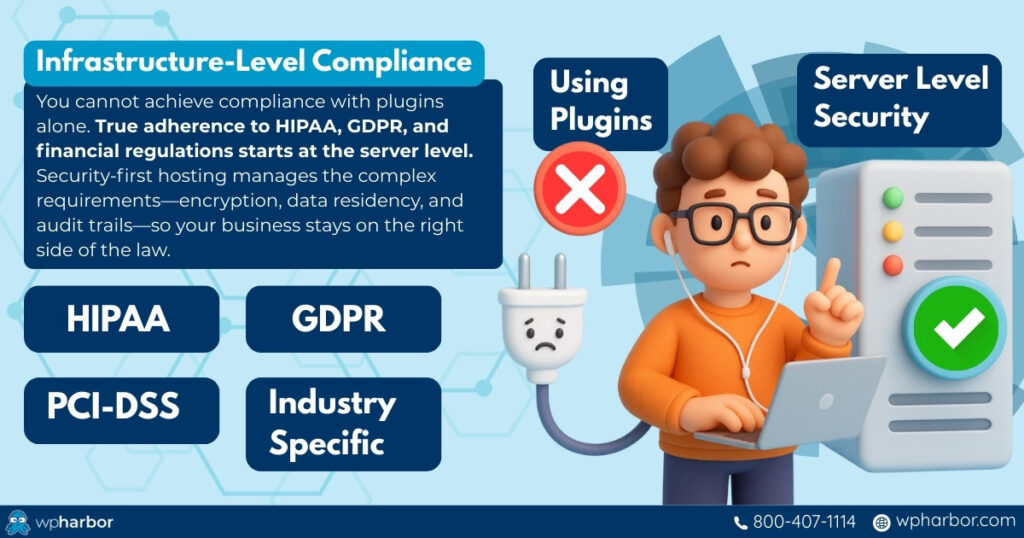
Compliance isn’t achieved at the plugin level, it starts with the hosting infrastructure. If the foundation isn’t compliant-ready, nothing built on top of it can be.
Why Regulated Industries Can’t Rely on Standard Hosting
Most hosting is designed for blogs, hobby websites, or small businesses. Regulated industries operate under far higher stakes, meaning the typical hosting environment is not designed to support the legal, performance, or security requirements they must uphold.
Standard Hosting Isn’t Built for Sensitive Data
Most shared hosting environments mix hundreds of sites on the same server. One compromised site can expose others. For industries handling sensitive information, this creates unacceptable risk.
Reactive Security Instead of Preventative Security
Basic hosting responds to issues after they occur. Regulated industries need protection that:
- Detects threats earlier
- Blocks attacks at the network edge
- Enforces strict access controls
- Monitors activity continuously
You can’t wait for a support ticket when legal exposure is on the line.
Downtime Creates Compliance & Operational Failures
For many regulated organizations, uptime isn’t about convenience, it’s about continuity of care, financial system reliability, or controlled access to legal information.
Every minute offline is a service failure.
No Audit Trails or Logging
Agencies and compliance officers must be able to review who accessed the site, what changes were made, and when. Standard hosting rarely provides granular logs.
Without these logs, proving compliance becomes nearly impossible.
Shared Responsibility Becomes Blurred
When something goes wrong, basic hosting providers often say: “That’s your WordPress issue, not ours.” But in regulated industries, finger-pointing doesn’t solve the problem, and it certainly doesn’t satisfy auditors or legal teams.
Security-first hosting eliminates ambiguity. It defines responsibilities, enforces standards, and ensures your organization never faces the consequences of insufficient infrastructure. Learn more about the types of hosting to better understand which type provides the best features for your organization.
How to Choose the Right Security-First Hosting Provider
Not all “secure hosting” is secure enough, and not all providers understand the realities of regulated industries. When evaluating a hosting partner, use these criteria to separate true security-first options from marketing claims.
1. Look for Infrastructure, Not Just Plugins
Security cannot be added after the fact. Your provider must offer:
- Server-level firewalls
- Automatic patching
- Encrypted backups
- Isolated environments
Plugins are helpful, but infrastructure is what protects you.
2. Ask About Access Controls & Authentication
Does the provider enforce:
- MFA?
- Role-based permissions?
- IP whitelisting?
- Automatic logout policies?
Lax authentication is one of the leading causes of breaches.
3. Check Backup and Recovery Policies
Security-first hosting should guarantee:
- Frequent automated backups
- Encrypted storage
- Fast, one-click restores
- Retention policies that meet compliance needs
If recovery is slow or unreliable, the hosting is not suitable.
4. Evaluate Their Incident Response Capability
You need a provider who treats security events like emergencies, not support tickets. Look for:
- 24/7 monitoring
- Fast response windows
- Clear escalation procedures
- Proven remediation processes
In regulated industries, hours matter. Sometimes minutes do.
5. Verify Compliance Documentation
Any competent security-first host should offer:
- BAAs (for HIPAA)
- DPAs (for GDPR)
- Security audits or certification reports
- Transparent data-handling policies
If they can’t document their security posture, they can’t support yours.
6. Assess Their Support Expertise
You’re not just looking for tech support; you’re looking for a partner who understands:
- WordPress security
- Compliance obligations
- Risk mitigation
- Infrastructure hardening
Support staff should be part of your risk management strategy, not an afterthought.

Security-First Hosting Isn’t Optional for Regulated Industries
In regulated industries, security is not a feature; it’s a legal, operational, and ethical obligation. The risks are higher, the rules are stricter, and the consequences of failure are far more severe. That’s why generic hosting simply cannot meet the standards required by healthcare providers, financial institutions, government agencies, education systems, or any organization responsible for sensitive data.
Security-first WordPress hosting gives you what traditional hosting cannot: a hardened infrastructure, compliance-ready systems, continuous monitoring, strict access controls, and a support team who understands that a security incident isn’t an inconvenience, it’s an emergency. With the right hosting partner, your organization gains protection, stability, and confidence that your digital environment aligns with industry regulations and withstands modern threats.
If your business operates in a regulated field, the question isn’t whether you need secure hosting, it’s whether your current hosting is strong enough to protect your users, your data, and your reputation. When compliance and security matter, your hosting must be part of your risk management strategy, not a blind spot.
If you’re ready to reduce risk and strengthen your security posture, explore WP Harbor’s Secure WordPress Hosting – engineered for industries where downtime, breaches, and compliance failures are not an option.
